Marie - Helene H.
Très beau jouet

Búsquedas populares
Buscar por presupuesto
1 toque para filtrarPor rango de edad
Selección rápida
No se ha encontrado ningún juguete
No hemos encontrado resultados para esta búsqueda. Prueba con una palabra clave más corta o con otro filtro de presupuesto.
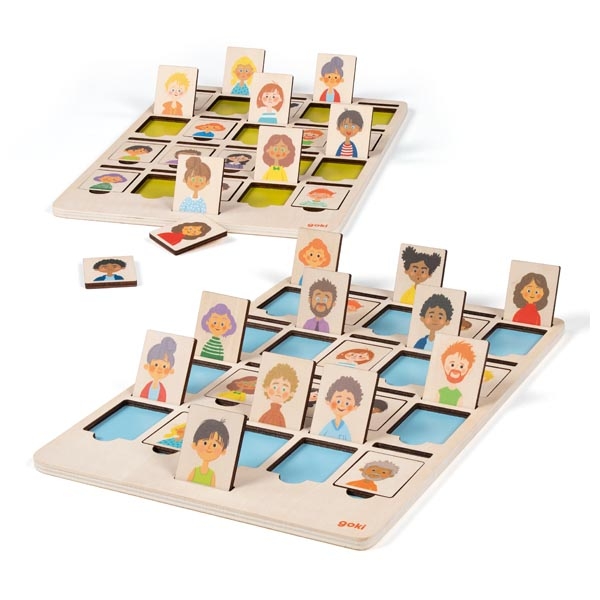
Ver los 600+ juguetes del catálogo →A guessing game for two players from 5 years: each of you hides a secret person, then asks yes-or-no questions about glasses, beards or hair to unmask the other's. Two wooden boards of 16 faces, tiles that fold flat, sold by Goki as a Who am I? guessing game.
Ref. : REFG56311
Each player sits behind their own wooden board. One board has slots with a lime-green background, the other light blue, so nobody mixes up their side. The 16 illustrated tiles slide into their slots and stand upright, faces turned towards their player. Then each of you draws a secret-choice tile at random: that is the person your opponent has to unmask.
The turn is easy to follow at 5. "Is your person wearing glasses?" If the answer is no, your child folds every tile with glasses flat into its slot. Question after question, only two or three faces are left standing, and that is the moment to risk a guess: "Is it the lady with grey hair?" The first player to name the other's secret person wins the round.
This guessing game works on the same question-and-answer idea as the Guess Who? game by Hasbro that many parents played as children. Here the boards and tiles are wooden, and your child handles each portrait by hand, standing it up at the start and laying it down when it is ruled out.
To ask a good question, your child first has to study the portraits: who has a beard or a moustache, who wears glasses, who has curly, tied-back or very short hair, who is a child and who is an older person. Pointing at "that one" gets nowhere; the game asks for a precise word. That is where this educational game works on language: describing a person accurately, understanding the other player's question and answering yes or no without a slip. It is also a genuine observation game, because any detail on a face can become the next question.
The second gain comes when your child realises that some questions are worth more than others. "Is it a woman?" can fold down a good part of the board, while a question about a rare detail often rules out a single portrait. Sorting the possibilities and choosing the question that eliminates the most is an early form of deductive reasoning, the same skill at work in our logic games.
The first time, play with everything in view. Put the two boards side by side, each choose a person and think out loud: "I'll ask about glasses, because then I can fold down several faces at once." Your child sees how one answer can clear part of the board. The usual mistake at the start is to guess a single face on the very first turn. Let them try it once, then compare with a broader question and watch how many more tiles go down.
Another trap: a wrong answer from one player spoils the round without anyone noticing. At the end, turn both secret tiles over and retrace the questions together; your child will spot where an answer sent them the wrong way. Once they have mastered the game, limit the number of questions each player may ask, or ban the words "girl" and "boy" so they have to look for other clues such as glasses, beards or hair colour.
Around 5, children play mostly with the clearest features: glasses, a beard, the colour of the hair. Between 6 and 8, they combine clues, count the faces still standing before they guess, and rounds become quicker and more tactical. Among the best games for 5-year-olds, the ones that last are those a child can win fairly against an adult, and here the random draw and the quality of the questions give them that chance.
That makes it one of the family games to play at home where a parent and child are on equal terms, and because it needs only a table and two players, it is easy to bring out as one of the indoor games for kids on a wet afternoon. As presents for five-year-olds go, it has the advantage of being something the giver can sit down and play. Older children enjoy it too, which keeps it on the list of presents for six-year-olds, including Christmas presents for six-year-olds who already like games with a winner. You will find more ideas for that age among our toys for 6 to 9 year olds.
For care, wipe the boards and tiles with a dry or barely damp cloth and never soak them: wood does not like water. After each game, lay the tiles flat in their slots and count them before putting the set away, so it is complete next time.
Goki sells it under the name "Who am I?", and as a Who am I? guessing game it keeps the classic face-to-face format. Compared with the versions most families know, this one is all wood: two boards of sixteen slots each and tiles that fold down into their slot as people are ruled out, 42 pieces in all.
The people on the tiles look like the people a child meets every day: children, adults and older people, light and dark skin, varied hairstyles, glasses, beards, moustaches and colourful clothes. The more the faces differ, the more questions there are to ask, and the more each round changes from the last.
It is a game for two players, no more and no fewer. To get the whole family round the table, have a look at our other board games.
Each player secretly draws a person. Taking turns, you ask one question about the appearance of the other player's person, which they answer with yes or no, then you fold down the tiles that no longer match. The first to find the opponent's person wins.
It is recommended from 5 years, the age when children can phrase a question about a detail and wait for the answer. It contains small parts and is not suitable for children under 3.
Two, each with a board of 16 portraits. Two children can also team up behind the same board and agree on each question before asking it.
Yes. Every question has to name a feature, so children build the vocabulary of the face: glasses, beard, moustache, curly or short hair, colours. If your child is learning another language, you can ask the questions in that language for a playful revision.
Warning: Not suitable for children under 3 years. Small parts. Choking hazard.
Información legal obligatoria relativa a la seguridad de los juguetes:
5+
Madera Natural Duradera
Certificado CE y EN 71, pinturas y ceras al agua no tóxicas
Nuevo (Embalaje original)
Limpiar con un paño suave ligeramente humedecido con agua tibia. Nunca sumergir en agua ni usar detergentes agresivos.
Para conservar el brillo de la madera natural con los años, aplicar una gota de aceite vegetal o cera de abeja 1 vez al año.
Este juguete aún no ha recibido opiniones individuales. Descubra las valoraciones certificadas de otras familias sobre nuestras creaciones.
Très beau jouet
Beau jouet mais la tête du clown rentre entièrement dans la bouche de mon petit fils (12mois) …. Ce qui ne me rassure pas !
Envoi rapide, produits conformes à la description.
Rapide, efficace et jeux top!
Astucieux ! Compris l'heure en un rien de temps, la mémoire a fait le reste. Ludique +++
Génial !
Otros materiales sensoriales pensados especialmente para esta etapa de desarrollo.